
Demystifying Quant Trading with AI: A Guide for Newer Coders

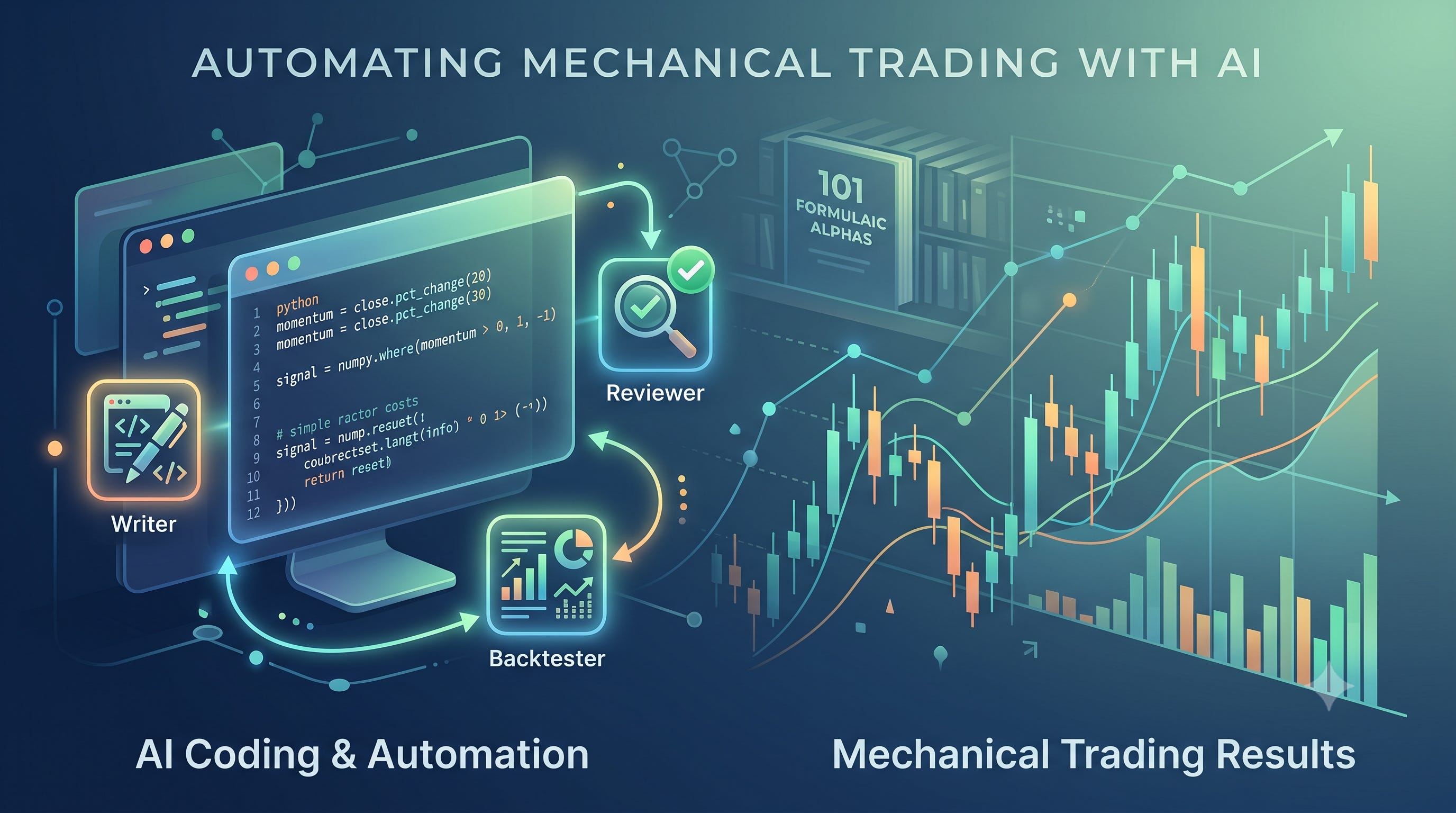
Welcome back! If you are new to AI coding tools like ChatGPT, Claude, or GitHub Copilot, you might be wondering how to apply them to real-world problems. One of the most fascinating areas you can explore is quantitative finance and the development of mechanical trading systems. Today, we are going to look at how AI is transforming the way developers build trading signals, often called “alphas.”
We will keep the math light and focus on how you can use these concepts to sharpen your AI coding skills.
Where Do These Alphas Come From?
Before we dive into the code, it helps to understand the origin of the “101 Alphas.” These signals were popularized by WorldQuant, a global quantitative asset management firm. The explicit formulas and computer code for these 101 real-life quantitative trading alphas were detailed in a well-known research document, 101 Formulaic Alphas. These were not just theoretical exercises; they were proprietary signals used in production by WorldQuant. By making these formulas public, the firm gave researchers and developers a clear glimpse into what some of the simpler, real-life alphas look like.
What exactly is an “Alpha”?
In quantitative trading, an alpha is simply a mathematical expression or computer code used to predict future movements of financial instruments. To give you a sense of their speed and how they operate, the average holding period for these specific WorldQuant alphas approximately ranges from 0.6 to 6.4 days.
How AI Coding Tools Change the Game
Historically, discovering these profitable trading strategies was a highly manual and labor-intensive process. Analysts had to brainstorm ideas, write the code, and backtest everything by hand.
Now, AI is stepping in to automate this. The research paper 101 Formulaic Alphas proposes an automated framework that leverages large language models to systematically generate, refine, and evaluate trading alpha strategies. By using a multi-agent system, AI can essentially talk to itself to write better code.
Here is how the AI workflow breaks down:
The Writer: A specific AI agent (the WriterAgent) generates the initial alpha code based on a text prompt.
The Judge: Another AI agent (the JudgeAgent) evaluates the generated code for correctness and logical soundness.
The Backtester: A BacktestEngine validates the refined candidate code on historical market data.
Digging In: Your Next Steps
If you want to practice using AI coding tools, quantitative trading formulas are a fantastic testbed. You can look at the open-source Python files to see how formulas are translated into executable Python code using libraries like Pandas and NumPy.
Here are a few takeaways for newer developers looking to experiment:
Start with established baselines: You can use the explicit code provided in these open source repositories to replicate and test alphas on historical data.
Use structured knowledge: Advanced AI coding frameworks integrate the WorldQuant 101 Formulaic Alphas as a structured knowledge prior to help ground the AI’s generation in proven mathematical patterns. You can prompt your own AI tools with these formulas to help it write better code.
Embrace AI roles: Multi-agent frameworks separate tasks across specialized roles. You can mimic this by asking your AI tool to first act as a “Coder” to write your script, and then act as a “Reviewer” to find bugs in it.
By combining foundational trading formulas with modern AI coding assistants, you can rapidly prototype complex data analysis scripts.
Have a Great Day!
Dave Johnson
Quant Developer at