
March Madness Bracket Simulator Tool
A Complete Guide to the Prediction Engine

I know this is a departure from my usual financial backtesting content, so please bear with me as I share a March Madness tool I’ve been building for a friend.
I posted about this tool last night and found some bugs in the outputs. Those should be buttoned up now. Give it a try and let me know what you think.
Every March, millions of people fill out brackets based on gut feeling, school loyalty, or whatever mascot they like. This year I did something different. I built a prediction engine powered by real analytics, 24 years of tournament history, and 25,000 simulated tournaments. Here is what it does and how to use it.
Test the Model for yourself :
https://indexpy-4rakw5m6bpkhnhm7dghoqn.streamlit.app/
What Is It?
Dave’s Bracket Madness 2026 is a free web app with the official 2026 bracket fully loaded - all 68 teams. It combines KenPom efficiency rankings, NET rankings, Quad-1 win percentage, strength of schedule, and historical tournament data into a single prediction system. Every calculation runs live in your browser.
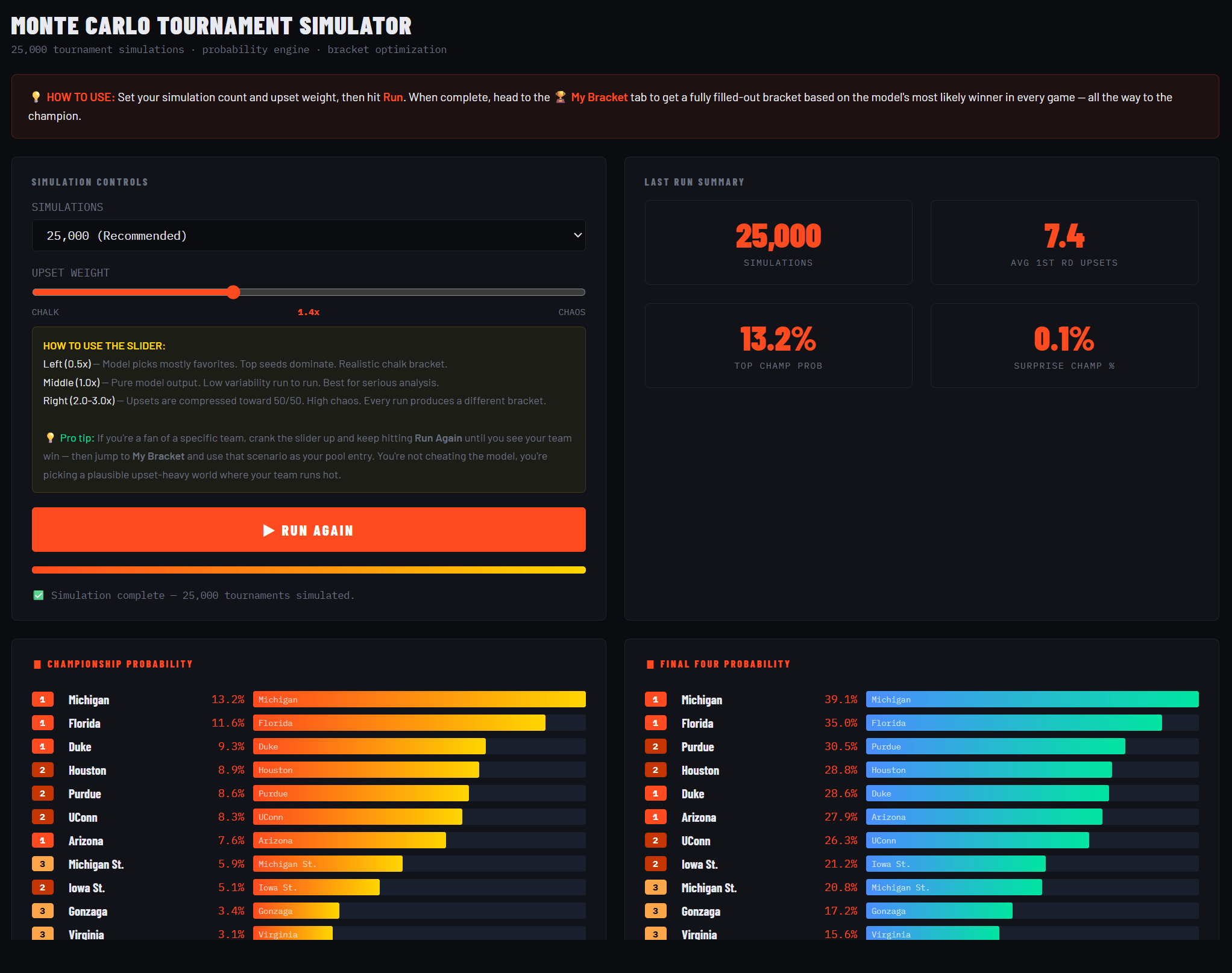
It is not just a power ranking. It runs 25,000 full tournament simulations and shows you the probability of every team winning the title, reaching the Final Four, and advancing each round - based on how teams with similar profiles have actually performed in March over the last two decades.
How the Model Works
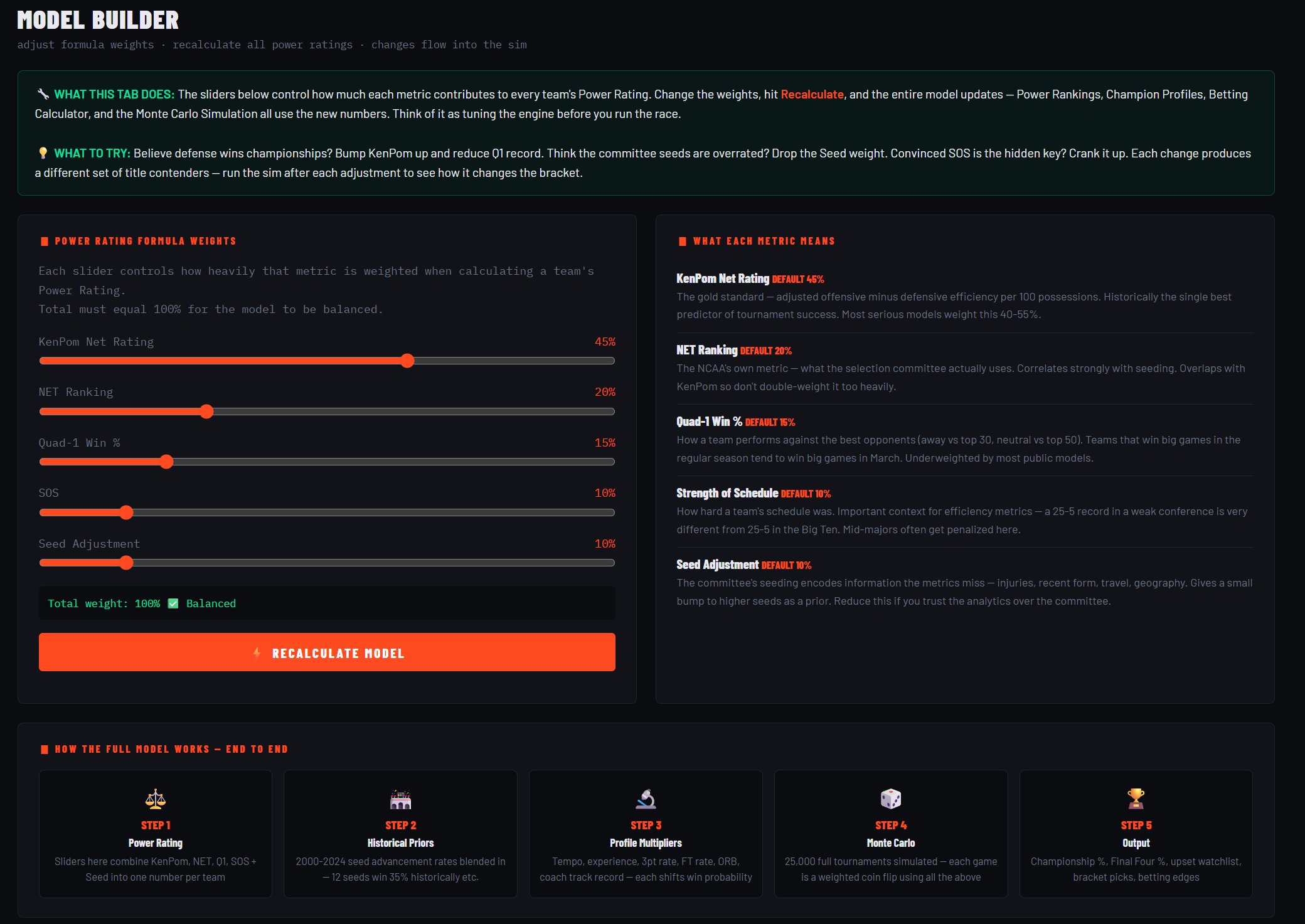
The engine runs in five stages. First it builds a power rating for each team by combining KenPom, NET, Quad-1 record, strength of schedule, and seed. Then it blends in historical seed advancement rates - 12-seeds win 35% of first round games historically, 8-seeds almost never reach the Final Four regardless of how good they are. Then it applies profile multipliers based on traits that predict over or underperformance in March specifically. Then it runs 25,000 full tournament simulations. Then it outputs everything: championship odds, Final Four probabilities, upset targets, a filled bracket, and betting edges.
The bracket shown at the bottom of the simulator is the actual result of the last simulation run - not a chalk prediction. Hit Run Again and you get a completely different universe where different upsets happened. That is the point.
Six Tools in One App
Power Rankings. All 68 teams ranked by the model’s power rating, with KenPom, NET, SOS, Quad-1 percentage, and - after running the simulation - championship and Final Four probabilities. Sortable by any column.
Monte Carlo Simulator. The engine room. Run 25,000 tournaments and see the championship probability for every team. The upset weight slider controls how chaotic each run gets. More on that below.
Upset Engine. Shows the eight factors that historically predict upsets - 3pt dependency, turnover pressure, tempo conflict, experience, rebounding, free throw rate, coach track record, and geography. Includes a watchlist of 2026 teams with the strongest upset profiles and a pool expected value table showing why picking underdogs is often the right move.
Champion Profile Analyzer. Scores every top-4 seed against the historical champion checklist. About 85% of champions since 2002 rank top-10 in KenPom, top-20 in both offense and defense, and are seeded 1-3. See which 2026 teams match that profile and which ones fall short.
Betting Edge Calculator. Select two teams and the model auto-fills their power rating, tempo, and offensive efficiency. Enter the Vegas spread or over/under and it tells you the model’s projection, the implied win percentage, and whether there is a meaningful edge. First round Thursday and Friday is the best window - books are pricing 32 games fast and lines are not sharp yet.
My Bracket. Run the simulation, come to this tab, click Generate. A full 64-team bracket fills in automatically based on what just happened in the simulation. Printable.
What the Model Knows About March
The most interesting part of the model is what 24 years of tournament data actually shows about which teams overperform and underperform their seed.
Slow tempo teams are chronically underrated. Virginia, Wisconsin, Saint Mary’s - teams that play in the low 60s possessions per 40 minutes - advance roughly 12% more than their seed predicts. They neutralize better opponents by controlling pace. Virginia’s tempo of 58 this year makes them quietly dangerous.
Three-point dependent teams are a coin flip. Alabama takes over 42% of their shots from three. That either means a hot shooting night that beats anyone, or a cold night that loses to anyone. The model treats them as volatile in both directions, which is exactly what the data says.
Experience wins in March. Senior-led teams reach the Sweet 16 at a 28% rate. Freshman-heavy teams manage 17%. That gap is enormous and persistent. Michigan State, UConn, Purdue, and Florida all carry high experience ratings. Alabama and Arkansas are on the wrong side of this split.
The 8 and 9 seed curse is real. Almost no 8 or 9 seed has ever reached the Final Four regardless of how good they are. The bracket forces them to beat a 1-seed to get there. The model applies a significant penalty to their advancement probability past the Elite Eight.
Coaching matters more than most models account for. Izzo, Hurley, Self, Pitino - the data on these coaches in the tournament is persistent and measurable across decades. Michigan State and UConn both carry real coach bonuses in the model.
The Upset Slider
This is the most important control in the app. It sits above the Run button in the simulator and goes from Chalk on the left to Chaos on the right.
At the middle setting the model runs as designed - some upsets, some variance, championship probabilities that reflect the real balance of power in the field. At 2.5 to 3.0 on the right side, all games compress toward 50/50 and every run produces a genuinely different Final Four.
The fan strategy: If you’re a UConn fan, slide it up to 2.5 and keep hitting Run Again until you see them win. That bracket is a legitimately plausible scenario - a world where your team ran hot at the right time. Jump to My Bracket and use it as your pool entry. It’s not cheating the model, it’s exploring a real possible universe.
Three Ways to Use It
For the Bracket Pool
Run the simulator at 1.0x, check the Championship Probability chart
Note the top 3-4 contenders - your champion pick is worth 40-50% of your final score in most pools
Check the Upset Engine for first-round targets, especially 11 and 12 seeds with strong profiles
Go to My Bracket and use the generated bracket as your base
Swap 1-2 upset picks where the model shows differentiation from public picks
For the Fan Bracket
Find your team in Power Rankings
Slide the upset weight to 2.0-2.5x in the simulator
Keep hitting Run Again until your team wins
Go to My Bracket - that is your pool entry
For Betting
Open the Betting Edge Calculator
Select both teams - stats auto-fill
Enter the Vegas line from your sportsbook
Look for spread edges of 2.5 points or more, total edges of 4 points or more
Best window is Thursday and Friday first round before lines sharpen
Tune It Yourself
The Model Builder tab lets you adjust how much each metric weighs in the power rating formula. Five presets are included: Default, Analytics Heavy (KenPom at 60%), Committee Thinking (NET and Quad-1 heavy), Defense Wins Titles, and Resume Based. Change the weights, hit Recalculate, and run the simulation again. You get a completely different set of title contenders and a different bracket.
What It Does Not Know
The model uses real metrics for all 68 teams and historical multipliers from actual tournament data. What it does not have: live injury reports, exact KenPom adjusted efficiency numbers (we use rank as a proxy), and real-time tempo data. For a bracket pool it is significantly better than gut picks. For serious betting, plugging in the actual efficiency numbers and current injury status would make it sharper.
The simulation variability is real. At the default setting, no single Final Four combination appears in more than about 1-2% of the 25,000 runs. That is March Madness - genuinely unpredictable, even with good data. Good luck.
You can find the tool here :
https://indexpy-4rakw5m6bpkhnhm7dghoqn.streamlit.app/
Enjoy!
Dave
Dusty May is the head coach of Michigan, not Juwan Howard.