
Forecast for Wednesday 1/21/26 - Oversold?
Revisiting the RSI 7 System

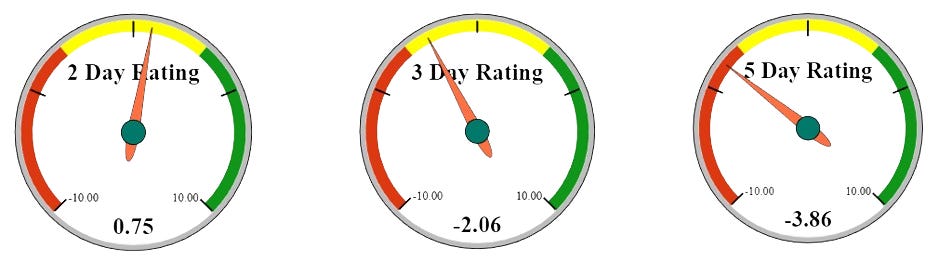
The forecast gauges are a bit mixed with the 5 day gauge rocking in to the Red zone. The only fly in the ointment is that the number of historical matches that we landed on was ONE. For your own reference that date was July 24th, 2024, which would have had an entry the following day. I had to open up the historical aperture a tad to get us to 10 matches. A small number of historical matches leaves us with less confidence. It is what it is.
The post last Thursday evening noting red in to Wednesday’s open was spot on. We got the forecasted weakness and now we’ve landed ourselves in a new place.
For tonight let’s go back to our study that looks at the 7 Period RSI crossing an oversold level. As many of you know I lean towards the 7 period RSI versus the standard 14 period because of its closer alignment with swing trading timeframes. I use that RSI as an input into many of my systems.
The rules are very simple to setup in the Wealth-Lab backtesting and trade automation software using the building blocks tool. The rules would look like this:
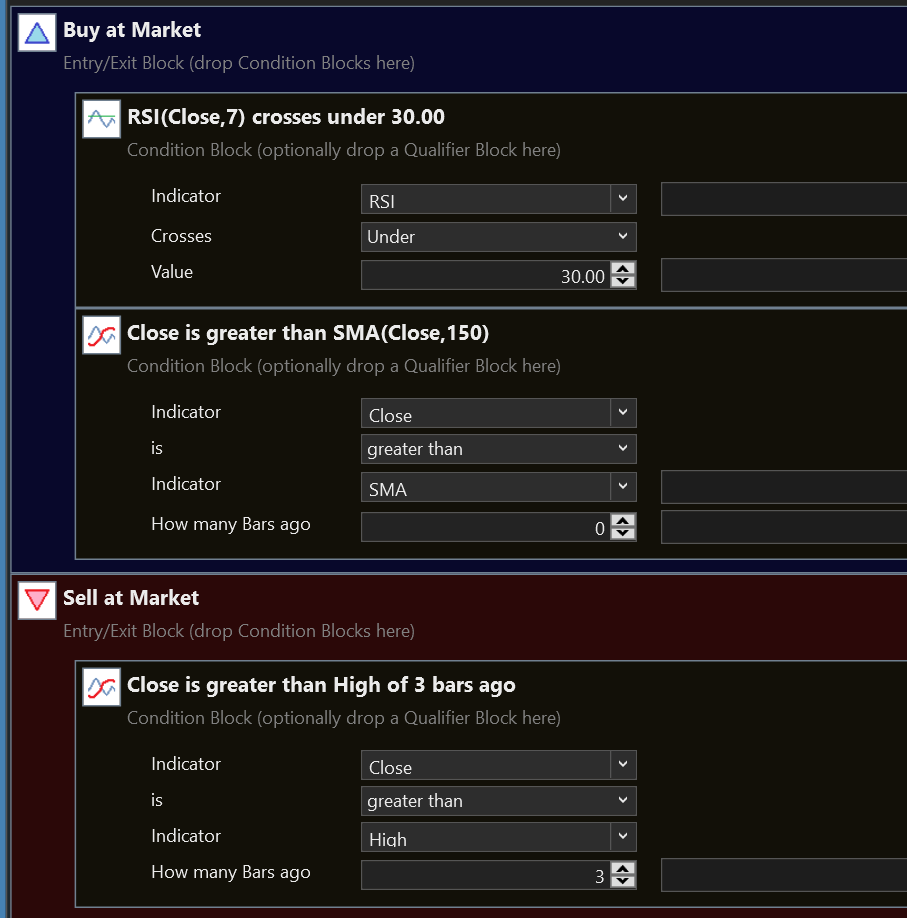
Rules: The RSI (7) crosses under 30 while being above the 150 period moving average. Simple right?
And the Exit: A close above the high of 3 days prior. That’s it. No stop. No profit target. Just exit with that specific rule whether it is above or below the your entry price. I’ve discussed this exit in other posts in the past. It is a testing default I apply across multiple timeframes whether its one minute bars, hourly, daily, or anything in between. It serves as an effective test of the weakness buying system’s efficacy because my research shows that if a downward trend is going to resume, a close above the 3 day prior high tends to be where it happens. This makes it a solid across the board exit point. The last time this trades setup occurred. I covered that exit strategy in detail here (you should review that.)
This condition is currently in place. The entry would be executed at tomorrow’s opening price in the SPY.
Here is an equity curve of applying those rules to the SPY since its inception in 1993
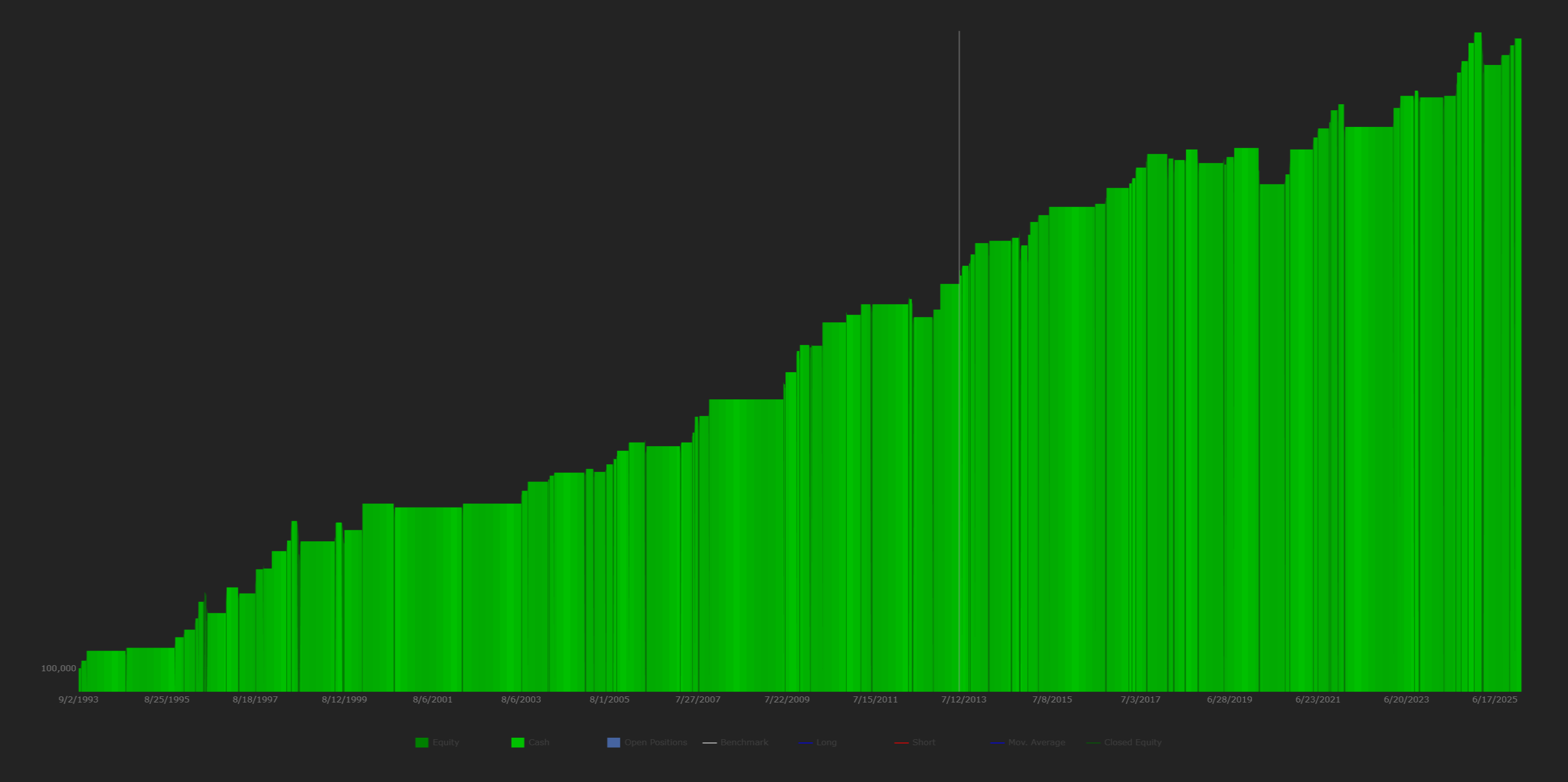
You can view all the historical entries and exits at the following link.
Just to clarify the mechanics of the entries and exits. They are the next day at the market open. As this is an “end of day” system. The market needs to close. The system is ran. Signals are generated and executed at the next days open. The same would be the case for the exit. Market closes, system confirms the signal, and the order is executed at the open the next day.
End of day systems fall within a particular class of systems. They are easy to execute for busy people without the ability to build or execute complex intraday systems. It is why I built the Elite SPY Trading System around the end of day concept.
The other characteristic I wanted was massive liquidity. As someone who builds and deploys systems monitoring over 6,000 symbols simultaneously across multiple small intraday timeframes, I know that backtesting and eventual deployment require careful analysis and monitoring of execution friction such as slippage and commissions. A few cents here and there on execution really add up. SPY is different. It’s a liquidity monster that can absorb very large market orders without any slippage.
Another aspect I wanted to encompass with the Elite SPY System was simplicity. I have helped hundreds of people through the years with deploying mechanical rules based systems. Almost exclusively they fall off the horse of executing the rules to the letter of the law (rules). The constant placement of orders and having periods of placing orders without the system moving out of a trading range, burns them out. They fall of the horse and then miss the eventual leg up in the system equity. They’ll also think they’re smarter than the system. They get away with skipping some trades to their benefit and then it becomes a habit. That habit again eventually leaves the trade skipper or modifier in the dust. Trust me on this. I’ve reviewed the transactions in clients’ portfolios on numerous occasions and usually with a sheepish grin they go “dude I effed up”. The Elite SPY system has maximum 2 orders you place before the market open. Simple.
The last piece that I wanted was a method that caused no issues in tax deferred retirement accounts. IRA’s, Roth’s and the like are your friend in long term wealth creation. This is incredibly important to allow excess tax free compounding on to of compounding. No options, futures, or complex volatility based products.
The RSI 7 entry would fall in to this type of system. End of day, simple, liquid, tax deferred friendly. The downside of this system is under the hood, this system alone is nothing special. It needs other system engines to improve its weak points. The main one being the frequency of the entries and exits is too low to drive high annualized returns. A single system is an island in a vast ocean. You do not want to hang your hat on one concept. It could have a crappy year and your left with meager performance and desperate need for market exposure during those strong rallies.
In future posts, we will discuss the pairing or grouping of systems to increase risk-adjusted returns. This is a highly misunderstood and underutilized aspect of systematic rules-based trading. We’ll get there…
Have a Great Night!
Dave Johnson - Quantitative Designer of the Elite SPY Trading System
Nice simple strategy. If you buy at the close instead of the next open, it improves the results about 20% overall. You can even automate that trade in WealthLab's Strategy Monitor with At-Close Processing a few seconds before the actual close.