
When SPY Pulls Back and VIX Spikes. The Numbers Might Surprise You.
Does triggering when the VIX is above 20 Help or Hurt

In previous articles I’ve shared a simple setup in the SPY ETF. The win rate and profit factors make sense for those looking for exposure in a pullback.
The rules are very simple. The 7 period RSI crosses under 30, while the SPY close is also above the 150 period moving average. The system would enter at the open the next day.
The exit is a close above the high of 3 bars ago, denoting a swing out from the low. Again, the exit would be the next day at the market open.
You can find a deeper description of that exit, along with the statistical history of the system below:
Forecast for Wednesday 1/21/26 - Oversold?

The forecast gauges are a bit mixed with the 5 day gauge rocking in to the Red zone. The only fly in the ointment is that the number of historical matches that we landed on was ONE. For your own reference that date was July 24th, 2024, which would have had an entry the following day. I had to open up the historical aperture a tad to get us to 10 matche…
Since that article, the condition triggered 2 times with both being winners.

The historical list of trades (not including the 2 shown above) can be found here
Yesterday the SPY triggered that setup again.
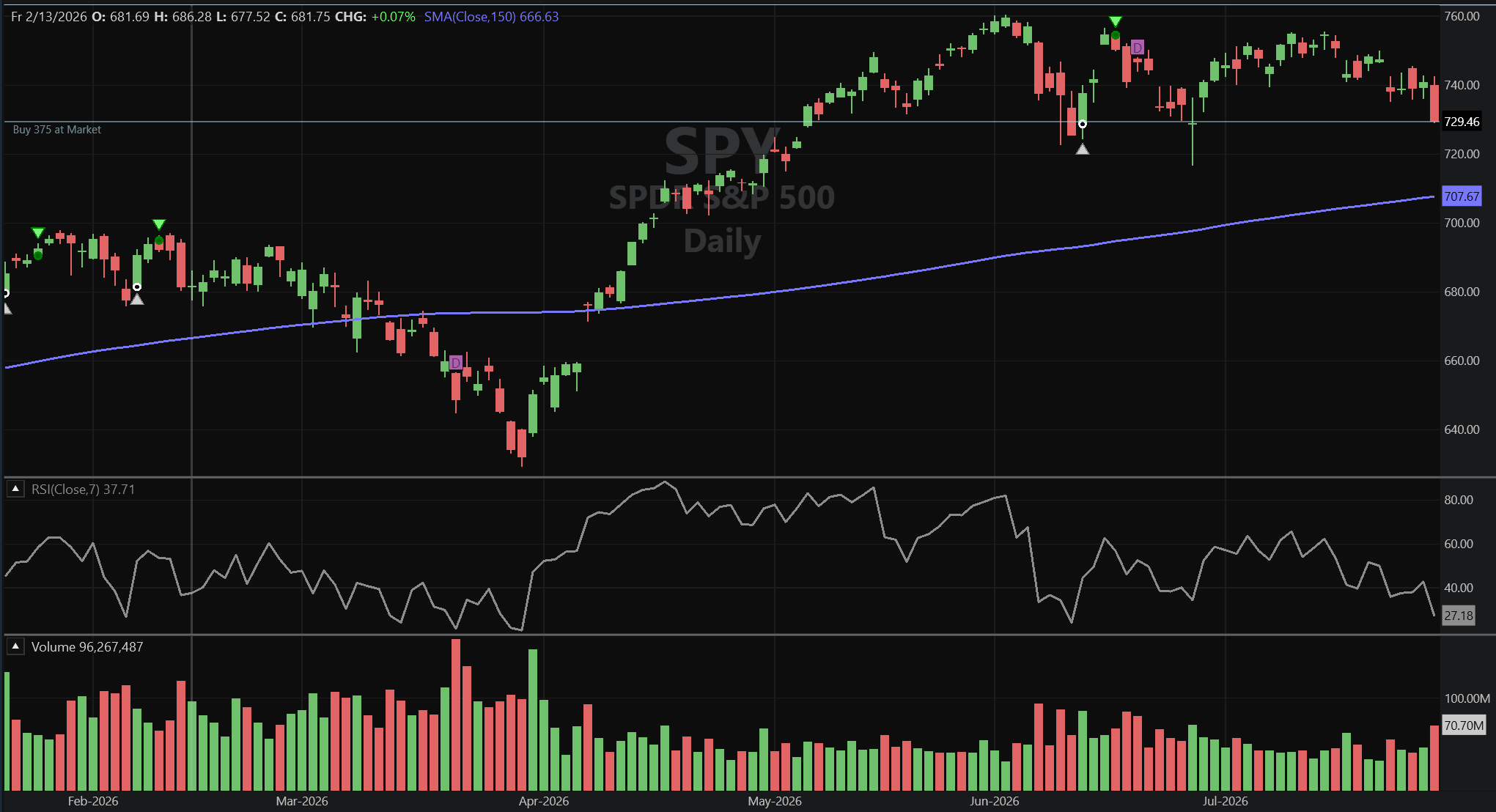
One thing I noted about the current signal is that the VIX is above 20, and that would not always be the case. I tested the system with that particular modification.
The RSI must cross below the 30 level and the VIX must close above 20. The exit rule is the same.
What I found were 57 historical triggers.
The stats are as follows:
85.96% Win Rate
Average Winner of 2.08% holding an average of 3.71 days
Average Loser of 2.20% holding an average of 9.88 days
Profit factor of 5.64
Compared to the original strategy:
81.19% Win rate
Average Winner of 1.7% holding an average of 4.29 days
Average Loser of 1.84% holding an average of 9.68 days
Profit Factor of 3.47
The differences are not huge. The average winner and loser expand as they are triggered in a higher volatility market. One thing I did note is the quicker average exit time for winners. 3.71 days versus 4.29 days, again this is likely due to the extra volatility in the market. In volatility price can cover more ground, more quickly.
As I’ve said with past triggers if you need market exposure, this method could help you gain that exposure. Typically you are in and out relatively quickly. One thing to note is that this is tested with no stop in place. The exit when triggered could be below the entry price. The path getting to an exit can be volatile. But if you need exposure, this is a straightforward way to get it.
On a sidenote I am putting the finishing touches on a new signal I will be offering on the website. This one is a bit different than my previous systems/signals, as it more of a warning of volatility popping in the near term as indicated by the VIX, rather than participating in long index equity.
The stats look like this:

The VIX itself is not a tradeable asset, but the signals can be a very powerful tool for those that want to protect long exposure, trade more selectively, improve the timing of shorts, and use long VIX options for protection.
Included with the purchase is a suggested use case manual using options and other alts. I’m going to make this one at a very approachable price so that as many people as possible can benefit and learn from it.
This is not meant to be a crash predictor. These signals fire when things are relatively quiet and capture smaller intermediate moves. They can trigger frequently when the market is calm and sidestep all markets that are highly volatile. It is a tool I have found most market participants lack.
I will be having a future post explaining the system and its use cases very soon.
Dave Johnson
Quant Developer at TradingTimeMachine.com
The VIX filter improves the historical profile, but the detail behind the win rate matters most: there is no stop, and losing trades are held much longer than winners. That makes position sizing and path risk just as important as the entry signal. A high win rate only helps if the trader can survive the few slow, uncomfortable losses without abandoning the system.
Or having no exposure. Is that better? Many think in trade, rather than exposure.. Does zero exposure get deployed in oversold conditions? The rules I defined are showing a condition. A simple fixed defined exit. Without the stop we can get a clearer look at how a more complex set of rules could be defined in the condition. This is a test of those simple conditions.